
Giuseppe Arcimboldo
«Hay chistes y hay chistes serios. El desplazamiento y la sorpresa, según Sigmund Freud, son elementos clave en los chistes serios: Si se coloca algo en un lugar que no esperamos encontrar, se plantean cuestiones provocadoras y divertidas. Giuseppe Arcimboldo (1526-1593), el mayor comediante visual del Renacimiento italiano, hizo del desplazamiento el tema de su arte.«
Robert Fulford
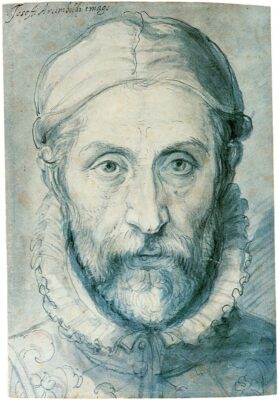
¿Antiguo significa «aburrido»? Bueno, es cuestión de gustos. Pero aquellos que contesten «sí», tal vez debieran hechar un vistazo a la obra pictórica del artista italiano Giuseppe Arcimboldo (1527 – 1593)
Giuseppe Arcimboldo: “Autorretrato”, c.1590. Galería Nacional de Praga
Nacido en Milán en 1526 o 1527, poco se sabe de la vida de Arcimboldo hasta que entró en la Corte del emperador Fernando I en Viena (posteriormente sería también pintor de cámara de Maximiliano II y de su hijo, Rodolfo II). Allí, Arcimboldo desarrolló una obra pictórica única e increíblemente imaginativa. De hecho, es posible que Arcimboldo sea, con la posible excepción de El Bosco, es el más original de todos los pintores del Renacimiento, un genio que con sus extraños retratos formados por elementos tales como frutas, animales u objetos, parece anticipar extrañamente vanguardias del siglo XX tales como el surrealismo. Para Gustav Hocke, Arcimboldo es «uno de los más extravagantes precursores del arte moderno«, mientras que Benno Geiger calificó «El Bibliotecario» de Arcimboldo como «un triunfo de la abstracción en el siglo XVI» (Werner Kriegeskorte: «Giuseppe Arcimboldo», 1991)
LAS CUATRO ESTACIONES
Arcimboldo pintó numerosas series de «Las cuatro estaciones» (una de ellas en una colección particular de Bérgamo, pintada hacia 1572; otra, hacia 1573, conservada en el Museo del Louvre) siendo cada una de ellas una copia sin apenas variación de la anterior, lo que refleja el éxito de la serie. El pintor ha representado los hipotéticos rostros de las estaciones mediante los elementos típicos de cada una de ellas. Así, el rostro de la primavera está formado por flores, el verano tiene rostro de frutos y cuerpo de trigo, mientras que el otoño es un curioso compendio de hojas caídas, setas, y frutos de cosecha. La serie concluye con el invierno, tal vez el retrato más complejo y menos descifrable de la serie, en el que se intermezclan elementos claramente secos y fríos, como la corteza que forma la cara, con otros más cálidos y vivos, como las hojas de la caballera y las dos frutas que cuelgan del cuello. Parece como si el alegre Arcimboldo se negase a sacar una cara amable a la menos amable de las estaciones.
LOS CUATRO ELEMENTOS
Al igual que en «Las cuatro estaciones», Arcimboldo vuelve a atribuir a cada elemento un rostro formado por lo más característico de cada uno de ellos. No obstante, la serie posee ciertos elementos que la hacen bastante diferente, e incluso más interesante, que la anterior.
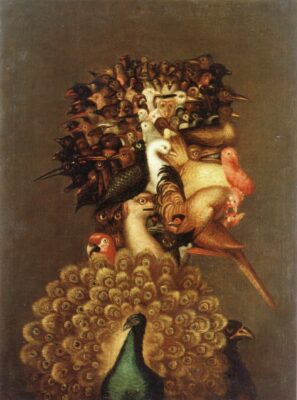
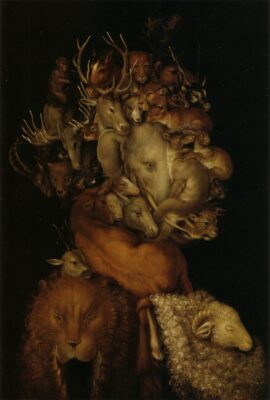
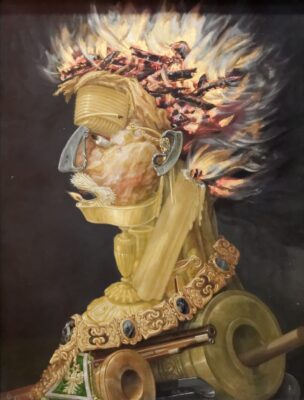
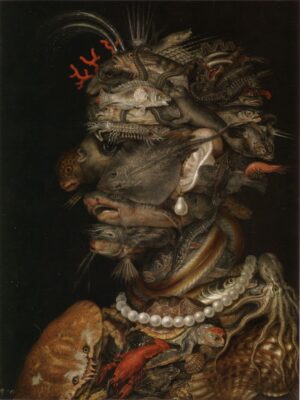
Giuseppe Arcimboldo: «Alegoría del aire» (copia), «Alegoría de la tierra», «Alegoría del fuego», «Alegoría del agua», 1566-1570
Para empezar, y a diferencia de la serie anterior, cada uno de los rostros está formado por un solo tipo de elemento compositivo. Así, el rostro de la tierra está formado solamente por animales terrestres, el del aire por aves, y el del agua por peces y animales marinos. Caso aparte es el fuego (Museo Histórico, Viena), representado por múltiples elementos flamígeros, desde unas brasas que hacen las veces de cabellera hasta unos cañones en el torso. Sin embargo, y a pesar de esta aparente limitación, las pinturas son bastante más conseguidas que en la serie anterior.
Además, hay que decir que la serie guarda una evidente relación con «Las cuatro estaciones». De hecho, ambas series están organizadas según en hipotético «eje de simetría», que enfrenta al aire con la primavera, al verano con el fuego, al otoño con la tierra, y al invierno con el agua.
RETRATOS
Pero Arcimboldo no se limitó exclusivamente a la creación de series de lienzos (elementos, estaciones) sino que pintó también numerosos retratos individuales, muchos de ellos para el Emperador Rodolfo II, en su original e inconfundible maniera.
Aunque el título de «obra más original de Arcimboldo» puede estar más que discutido, personalmente no dudaría en entregárselo al espectacular «El bibliotecario» (c.1566, Skoklosters Slott, Suecia), obra fabulosamente imaginativa, que, con sus formas geométricas y desbordante fantasía, parece anticipar las vanguardias del siglo XX.
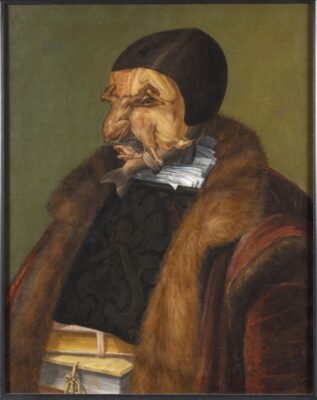
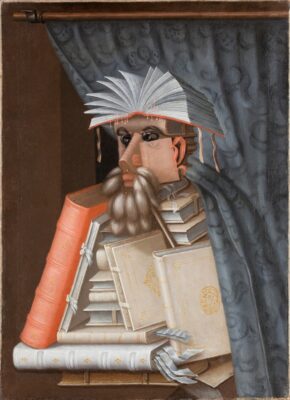
Giuseppe Arcimboldo: «El Bibliotecario», 1566, óleo sobre lienzo, Skokloster, Suecia. Giuseppe Arcimboldo: «El Jurista», 1566, óleo sobre lienzo, Museo Nacional, Suecia
El grotesco retrato de «El jurista» (dos versiones, una fechada en 1566 y que se conserva en Statens Konstsamlingar de Estocolmo; otra algo posterior en una colección particular de Milán) es una de las obras más polémicas de Arcimboldo. En primer lugar, ¿quién es el grotesco hombre retratado? Mientras que bastantes críticos sostienen que se trata del jurista J. U. Zasius, otros afirman que se trata del mismísimo Calvino. De cualquier modo, el rostro del hombre, que comparte ojo con el horrendo pollo desplumado, resulta realmente perturbador.
El retrato / bodegón de «Vertumno» ( c.1590, Skoklosters Slott, Suecia) es quizás la obra más ambiciosa de Arcimboldo, un exuberante retrato de Rodolfo II caracterizado como el dios Vertumno, que el poeta Gregorio Comanini describió así:
Mira la manzana, mira el melocotón
como se me ofrecen en ambas mejillas
redondos y llenos de vida
Fijate en mis ojos
de color cereza uno
el otro de color de mora.
No te dejes engañar, es mi cara.
Gregorio Comanini
«Flora» (c.1591, Colección particular, Milán) obra de madurez, pintada para deleite de Rodolfo II, es quizás menos imaginativa e interesante que las anteriores, pero de una perfección técnica fabulosa: es realmente admirable conseguir una representación tan detallada de cada una de las flores, en especial aquellas de la cabellera, y, a la vez, conseguir que el conjunto del retrato mantenga una unidad coherente.
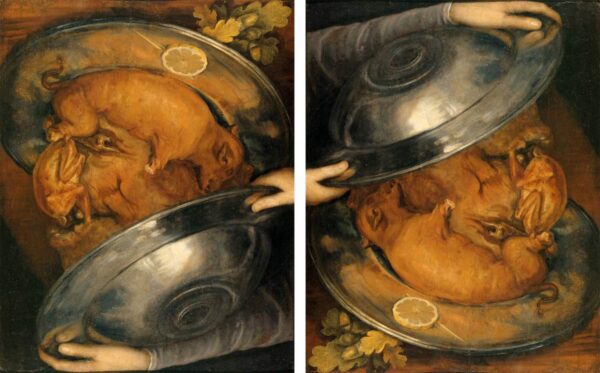
Giuseppe Arcimboldo: «El Asado» (invertido y normal), c.1570, óleo sobre lienzo, Museo Nacional, Suecia.
LA AMBIGÜEDAD DEL LIENZO – LOS RETRATOS INVERTIDOS
Quizás la máxima expresión de la originalidad de Arcimboldo sean los retratos invertidos, esto es, aparentes bodegones que, una vez girados 90º, se convierten en extraños y perturbadores retratos. «El asado» (c.1570, Colección particular, Estocolmo) y «El hortelano» (c.1590, Museo Cívio, Cremona) son los ejemplos más logrados y famosos.
G. Fernández · theartwolf.com
Follow us on: