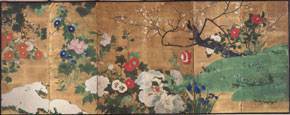
Saitō Ippo: Flowers of the Four Seasons, late 18th-early 19th century, Japan; ink and colors ongold leaf; six-fold screen; 36 ¾ x 95 ¼ in.; Clark Center for Japanese Art and Culture
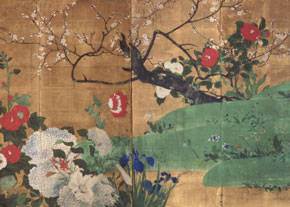
detail
Flowers of the Four Seasons: Japanese Art at Berkeley Art Museum Flowers of the Four Seasons: Ten Centuries of Art from the Clark Center for Japanese Art and Culture. BAM/PFA’s major fall 2010 exhibition Gives Bay Area residents an opportunity to view key pieces from one of the most significant collections of Japanese Art in North America
August 25, 2010–December 12, 2010
]]>
Source: Berkeley Art Museum and Pacific Film Archive
One of the most significant collections of Japanese artin North America will pay its first visit to the Bay Area for the University ofCalifornia, Berkeley Art Museum and Pacific Film Archive’s major fall 2010exhibition, Flowers of the Four Seasons: Ten Centuries of Art from the ClarkCenter for Japanese Art and Culture. BAM/PFA will display over 110 works ofart from the Clark Center of Hanford, California. The exhibition reflects thebroad collecting interests of the Center’s founder Willard G. Clark. His passionfor Japanese art and culture has resulted in a collection ranging from the lateHeian period (794–1185) to the twenty-first century, including all major areas ofartistic endeavor—screens, scrolls, wood sculptures, textiles, ceramics, andworks of bamboo
Clark studied architecture at UC Berkeley and animal husbandry at UC Davis inthe early 1950s. He started his art collection with modestly priced purchases ofart on his several visits to Japan from Hawai’i where he was stationed as a youngofficer in the United States Navy. After his release from the military in 1963, hetook charge of the family business, quintupled its size, and embarked on an evenmore successful venture exporting bull semen overseas. As Clark’s businessesgrew, so did the size and scope of his immense art collection. In 1995 he foundedthe Clark Center, a museum for Japanese art, to better protect these preciousworks and to make them available for public viewing. From 2002 to 2003highlights from the collection traveled to five cities in Japan, including Tokyoand Osaka, where they were admired by thousands of visitors. Given theCenter’s relative remoteness, too few in the United States have had a chance toview this important collection. The BAM/PFA exhibition will change this bypresenting to the public the most significant pieces from each of the key areas ofthe collection.
Much of the Flowers of the Four Seasons exhibition comprises work from theEdo, or pre-modern, period (1603–1868). The hanging scrolls and folding screenson display portray a variety of subjects; playful images of urban life, the elegantdiversions of nobility, portraits of Buddha, natural and idealized landscapes,flora, birdlife, and other animals. The overall effect of this variety of imagery is aremarkable view of the artistic creativity in Edo Japan.
Wood and polychromy Buddhist sculptures, dating from the Heian period to theKamakura period (1185–1333), are the oldest pieces in the exhibition. Movingforward in time, a portion of the exhibition focuses on late-twentieth centurybamboo sculpture. Japanese farmers and artisans plaited bamboo for hundredsof years, but it wasn’t until the mid-twentieth century that bamboo began to bethought of as a sculptural medium in its own right. Flowers of the Four Seasonshighlights signature works of some of the most significant modern bamboosculptors including Ueno Masao, Mimura Chikuhō, Nagakura Ken’ichi, andUematsu Chikuyū. Contemporary artist Fukami Sueharu’s collection of lightblue ceramic sculptures, with sleek edges and softly contoured planes that evokesword blades or ocean waves, round out the exhibition and demonstrate thatClark’s interests encompass both the past and the future of Japanese art.
Follow us on: