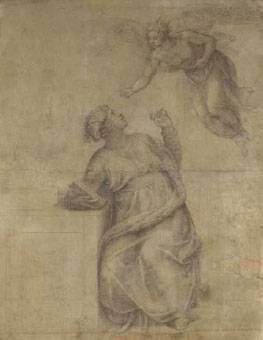
Michelangelo Buonarroti (1475–1564)
Annunciation to the Virgin
Black chalk, some stumping; traced with a
stylus
15 1/8 x 11 11/16 inches (383 x 297 mm)
Purchased by Pierpont Morgan, 1910; IV, 7
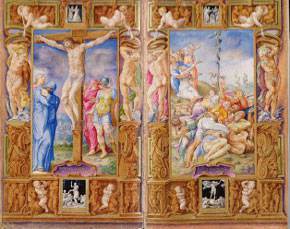
Illuminated by Giulio Clovio (1498–1578)
The Crucifixion
Moses and the Brazen Serpent
Farnese Hours
Italy, Rome, 1546
Purchased by Pierpont Morgan, 1903; MS M.69
(fols.102v–103r)
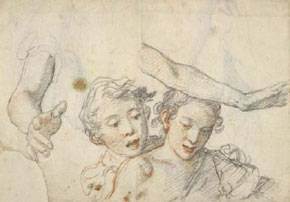
Federico Zuccaro (1542 or 43–1609)
Head and Shoulders of Two Boys and Separate Studies of a
Right and Left Arm
Black and red chalk
5 9/16 x 8 1/8 (144 x 207 mm)
Gift of Janos Scholz; 1974.24
Photography by Schecter Lee
Rome After Raphael – Morgan Library and Museum
Featuring more than eighty works selected almost exclusively fromthe Morgan’s exceptional collection of Italian drawings, theexhibition brings to light the intense artistic activity in Rome fromthe Renaissance to the beginning of the Baroque period,approximately from 1500 to 1600. The show is on view fromJanuary 22 through May 9, 2010
]]>
Source: Morgan Library and Museum
Among the prominent artists represented are: Baldassare Peruzzi, Polidoro da Caravaggio, Giulio Romano,Perino del Vaga, Parmigianino, Daniele da Volterra, Francesco Salviati, Pirro Ligorio, Pellegrino Tibaldi,Taddeo Zuccaro, Girolamo Muziano, Cesare Nebbia, Federico Zuccaro, Raffaellino da Reggio, andGiuseppe Cesari, called Il Cavaliere d’Arpino.
The exhibition also features Giulio Clovio’s sumptuousFarnese hours, one of the greatest illuminated manuscripts,as well as the Codex Mellon—an architectural treatise onkey Roman sites and projects, including Raphael’s designfor St. Peter’s—and a magnificent gilt binding of theperiod. Also on view is a Raphael workshop painting fromthe Morgan depicting the Holy Family, which has recentlyundergone a technical examination.
“The quality and importance of the Morgan’s collection ofsixteenth-century Italian drawings has long beenrecognized,” remarked Morgan director William M. Griswold. “Although individual sheets have appearedin major exhibitions in Europe and the United States, the Morgan has never before brought together somany outstanding works from this period and place in one show. Seen together for the first time, thedrawings convey the opulence and artistic diversity of this pivotal period.”
It was during the reign of Pope Julius II, elected in 1503, that Rome embarked on a century-long programof renewal and restoration. By the time Pope Clement VIII died in 1605, the overarching political andartistic ambitions of popes, cardinals, and foreign dignitaries had given rise to one of the richest periods in arthistory, transforming Rome into the unrivaled cultural capital of Europe.
Numerous drawings in the exhibition are related to Roman projects and commissions, including elaborateschemes for fresco decorations for city palaces, rural villas, and funerary chapels as well as altarpieces, tapestrydesigns, and views of recently discovered antiquities. The exhibition also opens a window into the artisticsensibility and lavish patronage of the period, from Julius II—patron of both Michelangelo and Raphael andarguably the most culturally sophisticated of the popes—to his successor Leo X and the “Gran Cardinale”Alessandro Farnese and his nephew Odoardo. Cardinal Ippolito d’Este and the Medici also generatedluxurious commissions as they competed to create their own legacies in chapels, palaces, and villas
Follow us on: