Crucifix

Giotto di Bondone: Crucifix, 1290-1295


Kiss of Judas

Giotto di Bondone: Kiss of Judas (fresco in the Scrovegni Chapel)


Ognissanti Madonna

Giotto di Bondone: Ognissanti Madonna


GIOTTO DI BONDONE

"Credette Cimabue nella pittura / Tener lo campo, ed ora ha Giotto il grido/ sì, che la fama di colui oscura "

Dante, Divine Comedy

In his "Lives of the artists", Vasari counts that in a quiet day, the Florentine painter Cimabue was walking by the field when he observed surprised a young shepherd, only a little boy, who was painting ewes on a rock with a white chalk. When the master answered for his name, the child responded: "My name is Giotto, and my father is called Bondone".

Be certain or not this anecdote, we can use it to make a first approach to Giotto di Bondone (1266-1337), the painter who, with his unusually imaginative talents, his original iconographies, and his remarkable love for the nature and the human expression, revolutionized the western Art to the point that many critics consider him, not without reason, the first name of the European painting, praised by his contemporaries Dante, Petrarca and Boccaccio. To his death, happened in 1337, at the age of 70 years, he left a school with category disciples (Bernardo Daddi, Taddeo Gaddi.) who directed the Florentine painting until the arrival of the great quattrocentist masters.

The first works of Giotto, still very close to Cimabue's stylistic features, already begin to show some of his original pictorial characteristics: it is the case of the Crucifix of the Church of Santa Maria Novella, in Florence (between 1290-1295), where the humanization of the figure of the Christ is completely different than the hieratic Byzantine crucifixes.

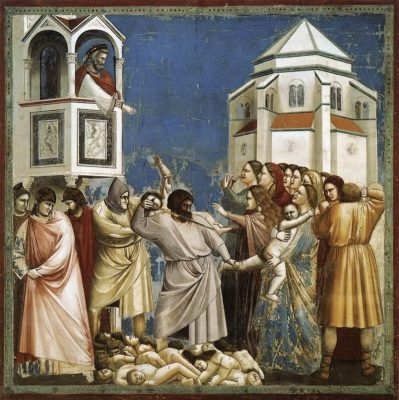
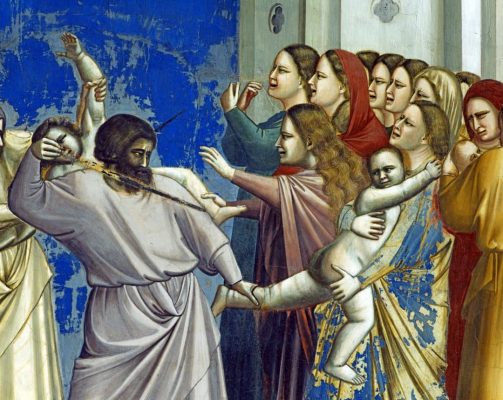
The first masterpiece by Giotto are the frescoes that he painted in the superior Church of the Basilica of San Francisco in Asis, between 1296 and 1300, based on the legend of San Buenaventura. Nevertheless, these works do not reach the perfection of those in the Scrovegni Chapel, in Padua, where, in addition to the individual quality of each scene (from the dramatic quality of The Massacre of the Innocents to the mysterious faces of the women in the Encounter of San Joaquin and Saint Anne ) the value of the space conception of the set of the Chapel is added. Giotto paints another series of frescoes for the Church of Santa Croce , already in his maturity (c. 1325)

In addition to the frescoes, Giotto made several paintings on table, highlighting the Madonna in Majesty (known as the Ognissanti Madonna ) in whom the face of the Virgin, far from the coldness and hieratic inexpressiveness of the Byzantines ones, shows a expressivity that suggests the possibility of that it has been taken from a human model, perhaps a Florentine young woman.

We also known that Giotto highlights in Architecture, receiving the assignment of the campanile in the Cathedral of Florence, although he probably only made a few sketches

Giotto is to the Italian trecento a phenomenon which all try to follow but nobody is able to reach until the appearance of Fra Angelico and the primitive flamenco masters of the early 15 th Century.

All Rights Reserved

Site Map | About Us | Manifesto | Contact | Terms of Use | Art Links | ©2008 theartwolf.com