
Mike Kelley · Biografía
Recuerdo nítidamente mi primer contacto directo con la obra de Mike Kelley (Wayne, Detroit, 1954). Fue en una ocasión que tuve la oportunidad de asistir a una exposición sobre la poco conocida y muy completa colección Herbert, en la que se encuentran representados maestros contemporáneos de la talla de Hans Hofmann, Robert Rauschenberg, Bruce Nauman, o escultores como Eduardo Chillida o Sol Lewitt. Allí, en una de las últimas salas, me encontré súbitamente enfrentado a la Memory Ware Flat #18 (2001). La espectacularidad de la obra era tal que ninguneaba a las demás obras de la estancia: los cientos, quizás miles, de piezas de bisutería, chapas de metal, llaves, llaveros, y demás objetos cotidianos suponían un excitante desafío para el espectador, llevándolo a un debate imposible entre la posibilidad de enfrentarse a la obra en su totalidad, o conformarse con la contemplación parcial de la infinidad de objetos cotidianos y fácilmente reconocibles. Resultaba francamente curioso que la unión entre unos pendientes del Todo a Cien, unas cuantas flores de plástico, pines de grupos ya pasados de moda, y una estampita de Flubber pudieran suponer un espectáculo equiparable a una vajilla completa del pleno esplendor de Quianlong.
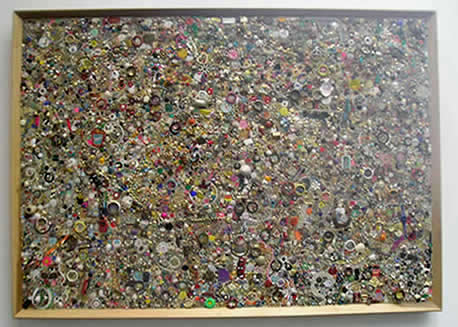

Mike Kelley: Memory Ware Flat #18 (2001) – Conjunto y detalle
No me fue fácil seguirle la pista a Kelley. Su obra, que comienza a ser abundante en los Museos americanos, es realmente escasa en Europa. Tan solo la Tate Gallery de Londres parece tener una completa representación de obras de la serie «The Uncanny», y el Centro Pompidou de Paris proyectó a comienzos de este año una serie de vídeos del artista norteamericano en el ciclo «Vidéo et après «.
El recorrido por la obra de Mike Kelley (Wayne, Detroit, 1954) comienza curiosamente por el mundo de la música. Kelley forjó los comienzos de su carrera artística en la tempestuosa escena musical americana de principios de los 70, formando parte de la banda Destroy All Monsters . Incluso después de trasladarse a Los Ángeles, en 1978, Kelley siguió colaborando con el mundo de la música, siendo responsable del diseño de la portada y libreto del disco Dirty de Sonic Youth.

Mike Kelley: Riddle Sphinx (1991)
©The Guggenheim Museum, New York (www.guggenheim.org)
Centrándonos en las Artes visuales, Kelley es uno de esos artistas inclasificables, cuya obra muestra claras influencias de la cultura popular, lo que no es de extrañar en un artista formado en la escena suburbana de Detroit. Las diversas fuentes de las que se alimenta la creatividad del artista resultan en obras ciertamente perturbadoras -desde las grandes instalaciones multicolores hasta figuras de animales o partes del cuerpo humano- a las que, no obstante, la rica policromía usada por Kelley les dota de un extraño e innegable atractivo.
Follow us on: