Caspar David Friedrich · Acantilados blancos en Rügen
1818 – 1819 – Óleo sobre lienzo – Oskar Reinhart Foundation, Winterthur
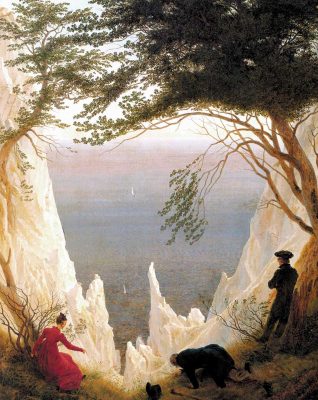
“Tan grande es la fuerza del espacio infinito, que su vacío adquiere el espesor de lo corpóreo”, escribió el crítico Werner Hofmann sobre esta pintura de Caspar David Friedrich, el romántico alemán por excelencia, que representa –de una manera más fantasiosa que realista- el viaje que el pintor, su esposa Carolina y su hermano Christian realizaron a la isla de Rügen en 1818.
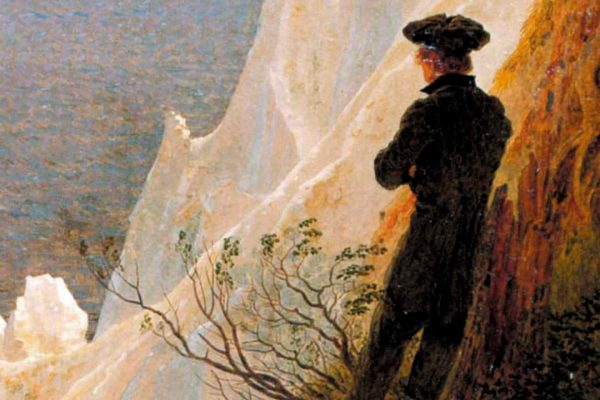
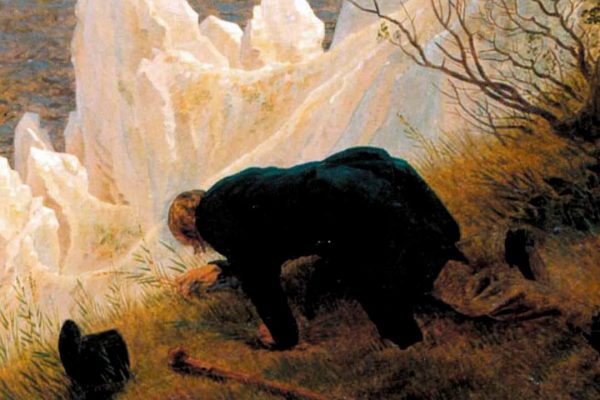
La representación de la figura humana enfrentada al espacio profundo e inabarcable es propio de la obra de Friedrich, que empleó este mismo efecto en obras tan famosas como “El monje frente al mar” (1808-10), “El mar de niebla” (1818) o “El coracero en el bosque” (1813-14), pero en el caso de esta pintura este contraste adquiere un significado distinto, de mayor complejidad pero menor dramatismo. Ya no se trata, como en las pinturas anteriores, de un espacio envolvente e incluso amenazante que subyugaba a las figuras presentes. En esta obra, Friedrich ha concedido a los protagonistas del cuadro el dominio sobre el poderoso paisaje, nada extraño si tenemos en cuenta que los representados son el propio pintor y su familia más allegada. Para ello ha usado un punto de vista muy elevado, y ha delimitado la visión de este espacio mediante las copas de dos árboles en la parte superior del cuadro. Pese a ello, y como bien ha señalado Hofmann, este espacio no pierde fuerza ni presencia, y se convierte en indiscutible protagonista de la composición, por encima incluso de los tres personajes y de las fantásticas formaciones calizas de los acantilados.
Texto: G. Fernández, theartwolf.com
Follow us on:
Caspar David Friedrich · Chalk Cliffs on Ruegen
1818 – 1819 – Oil on canvas – Oskar Reinhart Foundation, Winterthur
“So great is the strength of the infinite space that its emptiness acquires the thickness of the corporeal”: these are the words used by Art critic Werner Hofmann to describe this painting by Caspar David Friedrich, the most famous of all the German romantic painters. The work depicts –in a somewhat fantasized way- the journey that the artist, his wife Carolina, and his brother Christian made to the island of Rügen (Ruegen) in 1818.
The representation of a human figure facing the deep and almost infinite space is characteristic of Friedrich, who used this same effect in works like “The monk by the sea” (1808-10), “The sea of fog” (1818) or “The Chasseur in the Forest” (1813-14); but in this case the effect acquires a different meaning, more complex but definitely less dramatic. In the previously mentioned paintings, the surrounding and even threatening space subjugates the human figures. In this work, however, Friedrich gave the protagonists of the picture the dominion of the powerful landscape. For this purpose, the artist chose a very elevated point of view, delimiting the vision of this space using the branches of the two trees in the upper part of the picture. Despite all this, this space does not lose an inch of its strength, becoming the unquestionable protagonist of the composition, even over the three personages and the fantastic chalk cliffs.
Text by G. Fernández, theartwolf.com
Follow us on:
Chalk Cliffs on Ruegen
We use cookies. By clicking “Accept”, you consent to the use of ALL the cookies.
This website uses cookies to improve your experience while you navigate through the website. Out of these, the cookies that are categorized as necessary are stored on your browser as they are essential for the working of basic functionalities of the website. We also use third-party cookies that help us analyze and understand how you use this website. These cookies will be stored in your browser only with your consent. You also have the option to opt-out of these cookies. But opting out of some of these cookies may affect your browsing experience.