Pollock es la figura clave del expresionismo abstracto Americano, y recientemente se le ha considerado como la figura artística que limita las dos mitades en las que tradicionalmente se divide el siglo XX: la moderna y la contemporánea.
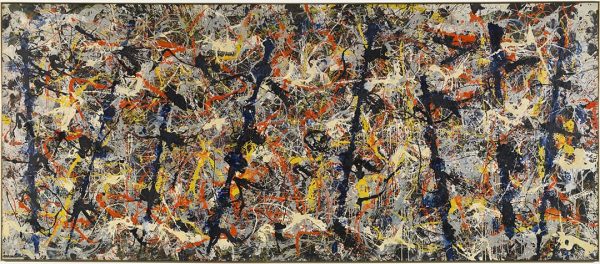
“Blue Poles” (“ramas azules”) es la culminación de la carrera artística de Pollock. Llamado “el mejor pintor de América” por la revista Life Magazine en 1949, creó sus mejores obras, sus famosos drips, entre 1947 y 1950. Tras estos fértiles años, comparables al periodo azul de Picasso o los meses finales de Van Gogh en Auvers, abandonó su propio estilo y sus últimas obras son usualmente pinturas sin gran interés. “Blue Poles” es, no obstante, un retorno repentino y extraordinario a sus máximos poderes, un drip poderoso en el que ocho líneas verticales (ramas) crean un extraño y dinámico contraste con las líneas ondulantes del “fondo”. En esta obra, así como en otras como “Summertime” (Londres, Tate Gallery), “Lavender Mist” (Washington, National Gallery), el “Out of the web” o el “Lucifer”, Pollock se revela como el colosal genio que, por medio del drip y el over-all, consigue canalizar la tremenda energía de su psique y plasmarla en gesto.
Texto: G. Fernández, theartwolf.com
Follow us on:
Jackson Pollock ·Blue Poles
1952 – Enamel and aluminium on canvas – National Gallery of Australia, Canberra
Jackson Pollock is the most important figure of American Abstract Expressionism, and “Blue Poles” is his last masterpiece, the culmination of his artistic career.
Labeled “America’s greatest painter” by Life Magazine (1949), Pollock created his best works -his famous drip paintings- between 1947 and 1950. After those fertile years, comparable to Picasso’s Blue Period or Vincent van Gogh’s final months in Auvers, he abandoned the drip, and his latest works are often bold and quite unexciting. “Blue Poles”, however, is a sudden and exciting return to his best period, a powerful drip in which eight great vertical lines (poles) create a strange and dynamic contrast with the undulating lines in the «background». In this work, as well as other masterpieces like “Summertime” (Tate Gallery), “Lavender Mist” (Washington, National Gallery), “Out of the Web”, «Autumn Rhythm» or “Lucifer”, Pollock is revealed as a dynamic and colossal genius able to canalize the tremendous energy of his psyche and turn it into a gesture.
Text: G. Fernández, theartwolf.com
Follow us on:
Blue Poles
We use cookies. By clicking “Accept”, you consent to the use of ALL the cookies.
This website uses cookies to improve your experience while you navigate through the website. Out of these, the cookies that are categorized as necessary are stored on your browser as they are essential for the working of basic functionalities of the website. We also use third-party cookies that help us analyze and understand how you use this website. These cookies will be stored in your browser only with your consent. You also have the option to opt-out of these cookies. But opting out of some of these cookies may affect your browsing experience.