
Henri Rousseau – biografía de El Aduanero Rousseau
¿Recuerdas, Rousseau, el paisaje azteca / las selvas donde crecen los bananos y los mangos / los simios derramando toda la sangre de las sandías / y el rubio emperador fusilado allá abajo? / Los cuadros que tú pintas, tú los viste en México / un sol rojo orna la frente de los bananos / y valeroso soldado, tú cambiaste tu túnica / por la chaqueta azul del honrado inspector de aduanas
Guillaume Apollinaire, 1908
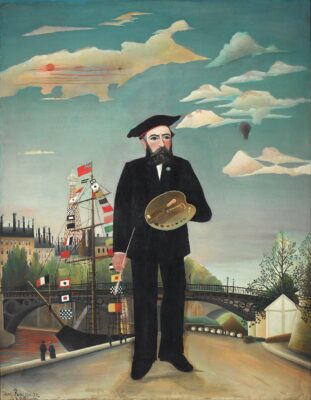
Naif, primitivista, salvaje… Múltiples adjetivos se han usado para describir a un artista inclasificable, quizás el más personal y desinhibido de todos los artistas surgidos inmediatamente después del ocaso del impresionismo. Henri «El aduanero» («Le douanier») Rousseau nació el 21 de mayo de 1844 en Laval, Francia, hijo de un hojalatero local. Al contrario que la mayoría de los famosos pintores de su generación, Rousseau no sintió de joven la llamada del arte, dedicándose a cumplir una condena -por el robo de 20 francos en un bufete de abogados- en el ejército en Angers y México. Esta condena, además de iniciar la fama de «salvaje» de Rousseau, provocó que éste no iniciara sus prácticas en pintura hasta principios de la década de los 70, copiando clásicos en los museos de Louvre y Versalles.
Imagen: Henri Rousseau: «Moi même (Yo mismo), autorretrato», 1890. Óleo sobre lienzo Galería Nacional de Praga
UNA NOCHE DE CARNAVAL – LOS COMIENZOS
En 1886 se inauguró en París una extraña exposición organizada por la Societé des Independants , en la que dos lienzos llamaron especialmente la atención: el primero de ellos, el célebre «Tarde de domingo en la Isla de la Grande Jatte«, de Georges Seurat. El segundo, » Una noche de carnaval«, de un desconocido agente de aduanas llamado Henri Rousseau. Eso sí, los motivos por los que destacaron fueron bien distintos: la obra de Seurat fue aplaudida por audaz y novedosa. La de Rousseau, con su estilo aparentemente burdo e infantil, provocó burlas y risas, hasta el punto de que sólo gracias a la intervención de Tolouse-Lautrec pudo Rousseau evitar ser excluido.
No era de extrañar: la mayor parte de la crítica, que a duras penas había admitido el impresionismo como tendencia artística aceptable, no estaba ni mucho menos preparada para el original estilo de Rousseau, que -sin embargo- no era en absoluto infantil o «ignorante». Por el contrario, se trataba de un valiente experimento modernista y meditado de un hombre buen conocedor de la Historia del Arte. El propio Picasso hablaba así de Henri Rousseau: «El caso de Rousseau no es ningún caso excepcional, sino que representa una forma perfectamente estructurada de ver las cosas«
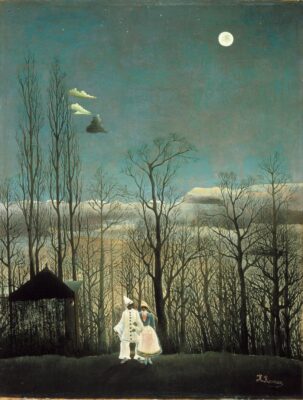
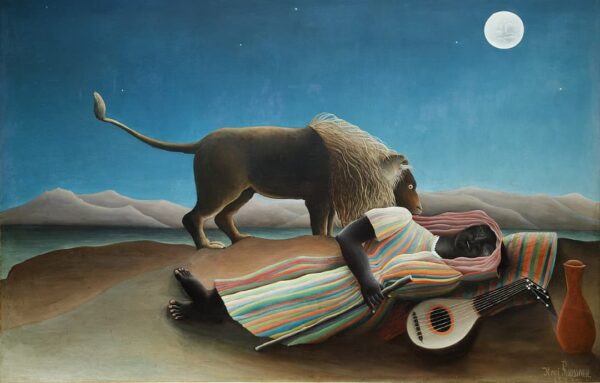
Henri Rousseau «Une soirée au carnaval (noche de carnaval)», 1886. Óleo sobre lienzo, 117.3 x 89.5 cm. Philadelphia Museum of Art ·· Henri Rousseau «La Bohemienne endormie (la gitana dormida)», 1897. Óleo sobre lienzo, 129.5 × 200.7 cm. Nueva York, Museum of Modern Art.
En el «Yo-mismo, retrato-paisaje» (1890, Národni Galerie, Praga) Rousseau hace un acopio de todas sus ideas pictóricas: la figura del pintor se inserta, sin ningún respeto por la perspectiva, la escala o el punto de vista, en medio de un paisaje en el que se representa, de forma bastante imprecisa, el Puente del Carrousel sobre el río Sena. La presencia del autorretratado es tan potente que no sólo ningunea el resto de figuras humanas de la composición, sino que su estatura supera incluso a la de la Torre Eiffel.
¡SORPRESA!
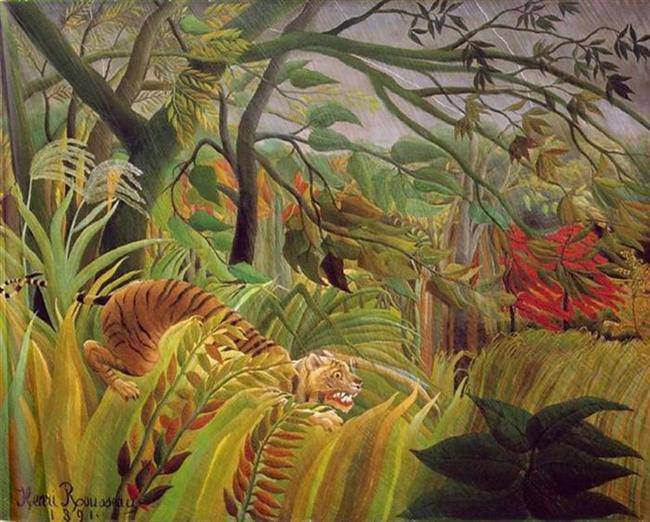
Ya comentamos que en sus primeras exposiciones en los «Salón des refusés» y «Societé des Indépendants», Rousseau causa asombro con su estilo primitivo y colorista, pero no es hasta 1891 cuando el Aduanero consigue causar un extraordinario asombro entre la crítica al exponer en el «Salón de los Independientes» el perturbador lienzo con el inquietante título de «¡Sorpresa!», que mostraba una acechante fiera en medio de un fantástico paisaje selvático. Describiendo la recepción de esta pintura en el salón, Cornelia Stabenow escribe que «Rousseau expuso un cuadro tan sensacional que todo lo demás quedó a la sombra (…) El efecto traumático sobre el público fue de tipo moral» (Cornelia Stabenow, «Henri Rousseau», 1994). Claramente influenciado por las plantas y árboles exóticos que el pintor observaba en los invernaderos y jardines botánicos, la obra supone un aviso sincopado de las pinturas selváticas que Rousseau pintaría a partir de 1904.
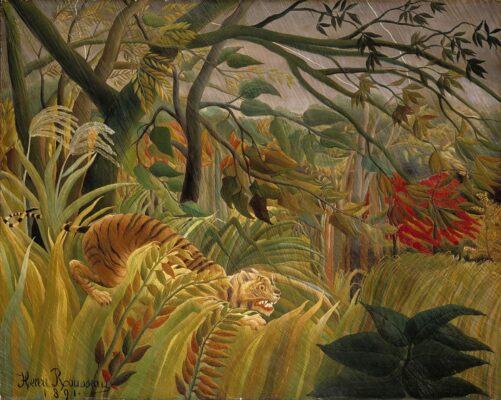
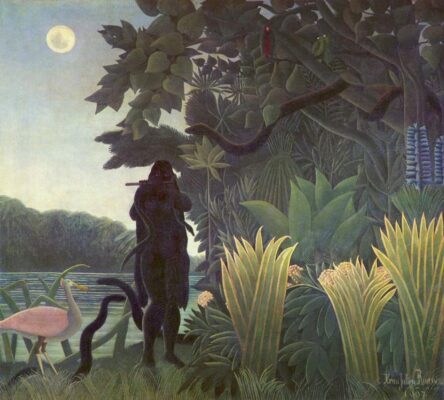
Henri Rousseau «¡Sorpresa!», 1891. Óleo sobre lienzo, 128.9 x 161.9 cm. Londres, National Gallery. ·· Henri Rousseau «La Charmeuse de Serpents (la encantadora de serpientes)», 1907. Óleo sobre lienzo, 169 x 189.5 cm. París, Musée d’Orsay
En 1894, poco después de jubilarse, Rousseau pinta uno de sus proyectos más ambiciosos: el terrible cuadro de «La Guerra» (1894, Paris, Musée d’Orsay) que llevaba el subtítulo de «Pasa rauda horrorizando a la gente y por todos los lados deja tras de si desesperación, lágrimas y destrucción» . El rostro de la Guerra es salvaje y terrible. En cambio, entre los muertos apenas podemos contemplar rostro alguno, como si Rousseau quisiera hacer que su alegato contra la Guerra fuese lo más universal posible.
En 1897, en el «Salón de los Independientes», Rousseau dio una vuelta de tuerca más a su leitmotiv artístico presentando «La Gitana dormida» (Nueva York, Museo de Arte Moderno), que llevaba el subtítulo de «La fiera, aunque salvaje, duda si lanzarse sobre su víctima, profundamente dormida de cansancio». La obra fue descrita así por Jean Cocteau: «¿De dónde cae semejante criatura? De la luna (.) La gitana no llegó hasta ese lugar donde duerme. Está allí. No está allí. No ocupa ningún lugar humano. Vive del reflejo.»
SUEÑOS DE LA SELVA
Contaba Salvador Dalí, acerca de su extraño cuadro «Impresiones africanas» (1938) que «África debe contar para algo en mi obra, porque, aunque nunca he estado allí, ¡la recuerdo perfectamente!» (Nathaniel Harris, «Vida y obra de Dalí», 1994). Algo parecido podría decir Henri Rousseau sobre las exóticas selvas americanas, que, a partir de 1904, se convertirían en el motivo fundamental de sus obras, sin haber cruzado jamás el Atlántico.
Ya en «Desagradable sorpresa» (1901, Barnes Foundation) Rousseau muestra a una bestia salvaje atacando a una indefensa mujer. Este cuadro -que impresionó al mismo Renoir- muestra el lado más terrible y violento de la naturaleza salvaje, como también se muestra en Lucha entre un tigre y un búfalo (1908, Cleveland Museum of Art), «Lucha entre un gorila y un indio» (1910, Richmond, Virginia Museum of Fine Arts), o «La comida del león» (1907, Nueva York, Metropolitan Museum of Art) Contrastando con la violencia de estos lienzos, encontramos la alegre narrativa de Los alegres bromistas (1906, Philadelphia Museum of Art) o el lirismo de «La encantadora de serpientes» (1907, Paris, Orsay)
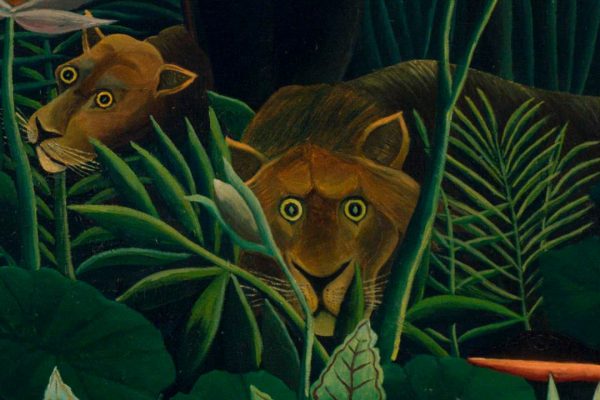
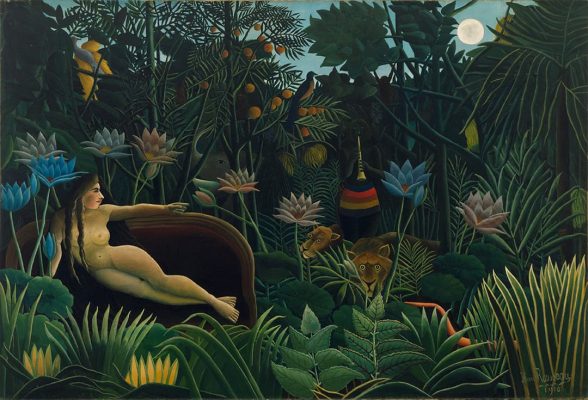
Henri Rousseau «Le reve (El sueño)», 1910. Óleo sobre lienzo, 204.5 × 298.5 cm. Nueva York, Museum of Modern Art. Conjunto y detalle
Pero la indiscutible obra maestra de este periodo, cumbre del arte de Rousseau junto con «La Gitana dormida» , es «El sueño» (1910, Nueva York, Metropolitan Museum of Art), una pintura sensacional que reúne en si misma toda la magia y fantasía del arte del Aduanero Rousseau, que explicaría la obra con este sugerente discurso: «La mujer en el sofá sueña que ha sido trasladada a este bosque y escucha el sonido de la encantadora de serpientes.«
Las fuentes de las que beben estas obras fantásticamente exóticas son tan complejas que nos obligarían a un viaje imposible dentro de la mente del Aduanero Rousseau, habitada por la admiración por «Las flores del mal» de Baudelaire, las poesías de su amigo Apollinaire, y la fascinación por la naturaleza salvaje tan típica de los artistas bohemios de finales del siglo XIX.
G. Fernández · theartwolf.com
Follow us on: