
Alfred Sisley en Port-Marly
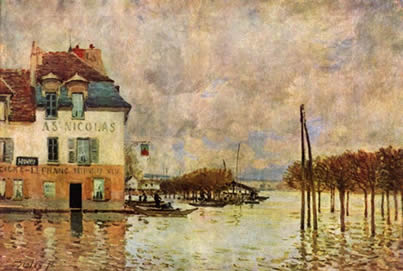
Las inundaciones en Port-Marly pintadas por Alfred Sisley
por G. Fernández – theartwolf.com
Al hablar de impresionismo, comúnmente se comete el error de adscribir a este movimiento a una serie de pintores que nada o casi nada tuvieron que ver con él -Henri Rousseau, Odilon Redon-, otros que, si bien comenzaron atraídos por el impresionismo, pronto se separaron de él -Paul Gauguin, Paul Cézanne- y otros que, si bien se consideran generalmente como representantes de este movimiento, no pueden considerarse como puramente impresionistas, bien por desarrollar su estilo antes de la eclosión impresionista -Édouard Manet- o bien porque sus inquietudes los llevaron a emplear una técnica o temática que difería de la de este movimiento -Edgar Degas, Pierre-Auguste Renoir-. Si quisieramos, cayendo quizás en un purismo arriesgadamente simplista, dar una lista de figuras representantes del impresionismo puro y esencial, sin interferencias de otras corrientes, dicha lista terminaría por reducirse a muy pocos nombres: Claude Monet -el auténtico Miguel Ángel del impresionismo-, Camille Pissarro -el gran cronista de la vida rural-, Berthe Morisot, y Alfred Sisley.
Después de la inundación – Sisley en Port-Marly
Alfred Sisley (1839-1899) fue por encima de todo un paisajista. De menor ambición que Monet, y menos inquieto que Pissarro, Sisley se sintió desde el principio atraído por el paisaje fluvial, tanto por el río en si mismo, especialmente por los reflejos en la superficie del agua, como por la medio humano en sus alrededores. En cualquiera de los dos sentidos, sus obras claves son aquellas que dedicó, en 1872 y 1876, a las inundaciones causadas por el río Sena en la localidad de Port-Marly.
Sisley pintó varios lienzos representando la crecida del Sena en Port-Marly, pero las dos composiciones más destacadas son aquellas que recogen la inundación ante la tienda de un comerciante de vinos de la Rue de Paris. Es de destacar que varios pintores, como Claude Monet, ya habían representado pictóricamente grandes inundaciones, pero Sisley introduce la novedad de recrear estas inundaciones afectando a lugares habitados. La línea del horizonte, inusualmente baja, hace recordar a las vistas de la Escuela del Delft y las vistas de Venecia pintadas por Joseph Turner, que Sisley tuvo oportunidad de ver durante un viaje a Londres. Curiosamente, las distintas vistas pitadas por Sisley tienen una composición similar: la arquitectura presente en la parte izquierda del lienzo divide el cuadro en dos partes: la inundación afectando al medio humano y construido -a la izquierda- y al medio natural y vegetal, a la derecha del mismo.
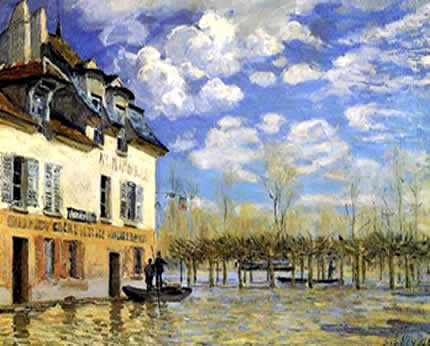
Al contrario que en la mayoría de pinturas representando incidentes naturales, aquí Sisley no añade a la composición ningún tinte trágico o catastrofista. No observamos ni edificios derruidos, ni árboles caídos, ni puentes arrastrados por la fuerza de las aguas. En uno de ello, incluso, el aspecto del cielo, lejos de ser amenazante, resulta esperanzador, con grandes claros azules abriéndose paso entre las nubes. Los personajes que montan las barcas que surcan las aguas recuerdan más a plácidos gondoleros venecianos que a asustados vecinos intentando salvar sus objetos personales de la fuerza de las aguas.
Pintor precoz, de familia acomodada, Alfred Sisley conoció muy pronto a los grandes pintores de su época, y fue admitido en el primer Salón al que se presentó, en 1866. No obstante, su forma de vida quedaría truncada en años posteriores. La guerra franco-prusiana de 1870 arruinó por completo a su familia, enviándolo a una pobreza de la ya no saldría, ya que fue rechazado en los Salones de pintura posteriores, y tan solo el galerista Durand-Ruel compraría algunas de sus pinturas. Así, es posible sugerir un nexo de unión entre estas pinturas y la agitada biografía de su autor: tal vez Sisley veía las inundaciones en la plácida localidad de Port-Marly como un reflejo de su propia vida accidentada, desbordada, tras unos acontecimientos tan imprevisibles e inevitables como la crecida de un río.
Follow us on: